


Principles
In response to both external and internal fundamental changes and trends are shaping up to be a sustainable organization where an organization continues to evolve its risk management and sustainability priorities to strengthen business foundation.
Golden Lime Public Company Limited (SUTHA) is committed to developing its business operations to be in line with the sustainable development framework and has applied guidelines in accordance with the sustainability assessment criteria of listed companies on the stock exchange and the policy framework according to the expectations of key stakeholder groups in order to Framework for guidelines for setting directions Development drives business sustainably with responsibility towards society, the environment and stakeholders. The " Policy Framework for Sustainable Development and Environmental and Social Responsibility_ESG Policy" is as follows
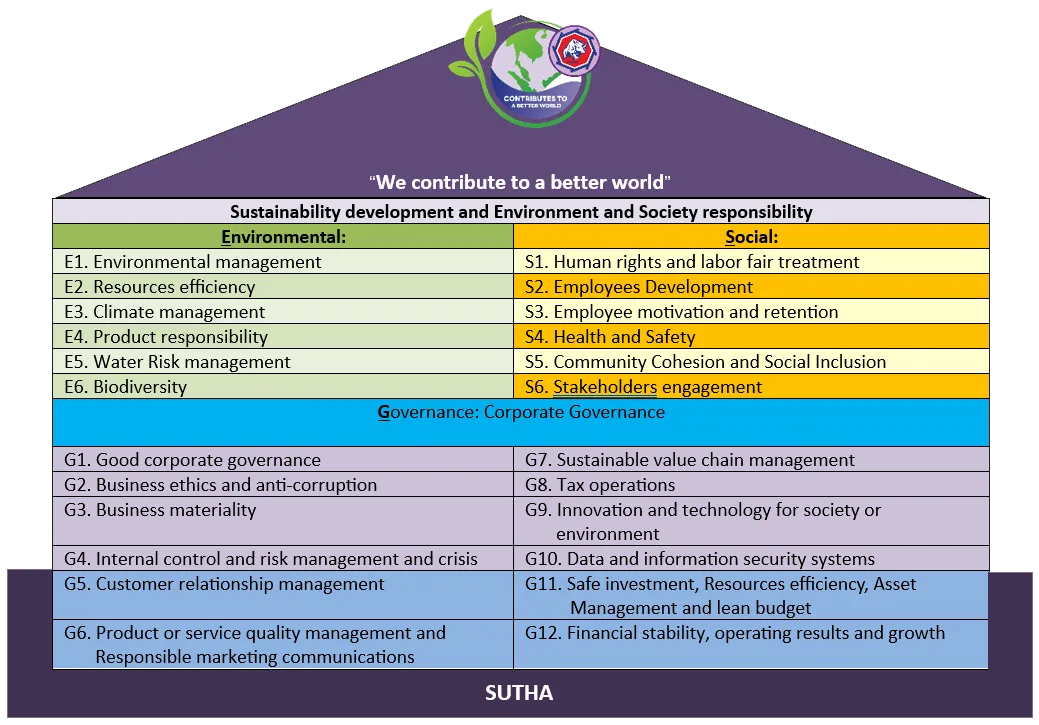
“We contribute to a better world”
Sustainability development and Environment and Society responsibility
Environmental
E1. Environmental management
E2. Resources efficiency
E3. Climate management
E4. Product responsibility
E5. Water Risk management
E6. Biodiversity
Social
S1. Human rights and labor fair treatment
S2. Employees Development
S3. Employee motivation and retention
S4. Health and Safety
S5. Community Cohesion and Social Inclusion
S6. Stakeholder Involvement and Participation
Governance
G1. Good corporate governance
G2. Business ethics and anti-corruption
G3. Business materiality
G4. Internal control and risk management and crisis
G5. Customer relationship management
G6. Product or service quality management and Responsible marketing communications
G7. Sustainable value chain management
G8. Tax operations
G9. Innovation and technology for society or environment
G10. Data and information security systems
G11. Safe investment, Resources efficiency, Asset Management and lean budget
G12. Financial stability, operating results and growth
E1. Environmental management
Principles
Adhere to ISO 14001 to ensure efficient environmental operations to reduce risks and expenses that may result from violations or consequences of non-compliance with environmental requirements.
Guidelines
- Environmental management in accordance with ISO 14001
" The Environment policy "is as follows:
Golden Lime Public Company Limited is committed to responsibly manufacturing and distributing calcium oxide, calcium hydroxide and calcium carbonate with quality according to customer needs with environmental awareness by continuous environmental improvement and development in accordance with the laws, Environmental customer requirements and other requirements as per following
The Company has therefore established the following guidelines
- Promote energy and natural resources optimization, prioritize resource efficiency
- Pollution-control strategies, in general, seek to manage a pollutant and reduce its impact upon the environment
- Set objectives, goals and continuously improve environmental operations.
- Adherence to environmental laws, regulations, guidelines, and specifications relevant to business processes.
- Providing information and training to all employees and persons working for, or on our behalf to encourage effective contribution to our environmental goals.
This policy is in writing. and conveyed to all employees and those working on behalf of the organization to put into practice continuously which can be disclosed to the public
2.designated persons to manage environmental issues
- Targets, indicators, and controls are in place
- Disclose quantitative outcome obtained from environmental treatment and products
Air Quality Management
Principles
The production of limestone and lime involves grinding and crushing limestone, as well as processing calcium carbonate. This process generates dust, smoke, and gases that can contribute to air pollution and degrade air quality. To mitigate these effects, policies and guidelines have been established to minimize the impact and implement measures aimed at controlling and preventing dust-related issues that may affect nearby communities.
The Company has established the following management guidelines:
- Regulatory Compliance:
- Adhere to relevant local, national, and international environmental laws and regulations.
- Apply best practices and standards for managing air quality
- Pollution Prevention:
- Prioritize pollution prevention at the source by altering or creating manufacturing processes that utilize materials to lessen impacts and enhance operational efficiency.
- Encourage the adoption of clean technologies and renewable energy options.
- Pollution emission Control:
- Implement and maintain state-of-the-art emission control systems to capture and minimize pollution.
- Consistently monitor and document emissions to ensure adherence to environmental regulation
- Continuous Improvement:
- Perform environmental impact assessments and regular audits to pinpoint areas needing enhancement.
- Allocate resources for research and development to discover innovative pollution control methods.
- Stakeholder Engagement:
- Maintain open communication with stakeholders regarding environmental performance and initiatives.
- Collaborate with communities, government bodies, and other organizations on projects aimed at improving air quality.
- Employee Engagement:
- Provide education and training for employees on environmental policies and practices.
- Encourage employee involvement in environmental initiatives and ongoing improvement efforts
Dust and Gas Control Measures:
- Dust and gas control system: Implement a system to minimize dust and gas emissions from production activities.
- Closed system: Utilize a closed system for material storage management to prevent dust dispersion.
- Water spraying: Employ water spraying methods to control dust during material handling and transport.
- Green buffer zone: Establish a green buffer zone by planting trees and vegetation around the facility to mitigate dust.
- Regular cleaning: Ensure equipment, vehicles, and facilities are kept clean to avoid dust buildup.
- Inspection and reporting: Continuously assess air quality and provide reports to relevant authorities.


Noise controls and mitigations:
The production process will involve sources of noise, such as the large fan system (Blower System), which is housed within a closed concrete structure. Other noise sources will not include heavy machinery but will involve control devices used in the process. These control devices are implemented to mitigate noise pollution and ensure compliance with noise control regulations.
- Noise control system: Implement a system designed to minimize noise emissions during production.
- Use of noise-dampening materials: Incorporate materials that reduce noise in both production and construction activities.
- Equipment upkeep: Regularly clean and maintain equipment to minimize noise generation.
- Monitoring and reporting: Routinely assess noise levels and communicate findings to the appropriate authorities.
Wastewater quality management without discharge :
- An internal wastewater treatment system that utilizes water circulation for coagulation and reuse
- The use of lime in the coagulation process, which is an eco-friendly approach to wastewater treatment.
- Equipment upkeep: Ensure cleanliness and proper maintenance of treatment system equipment, water pumps, and related components.
- Ongoing inspection and reporting: Regularly monitor wastewater quality and communicate findings to the appropriate authorities.
Water utilization in the production process involves:
Spraying water to clean stones prior to their introduction into the kiln for burning.
Water management system:
- A pond and piping system are in place to redirect used water back to the storage tank.
- Used water will settle in the tank.
- Water is recycled following the sedimentation process.
Sludge in the pond:
- mud from the stone washing and cement dust from production activities.
- Dredging and removal for various uses, such as:
- Leveling the factory grounds
- Donating to temples, schools, and local communities.
- used for land filling
Wastewater Quality Monitoring:
Measurement operations yield results that meet the specified standards, except for pH, which ranges from 5.5 to 9.0.
Remark:
The water properties used in the company's system showed a pH value between 11 and 13 during inspection, indicating high alkalinity. This is due to the use of lime products, which exhibit high alkalinity when water circulates within the production process. The water quality measured reflects this high alkalinity. However, since the factory's wastewater system operates as a closed-loop system and does not discharge into the environment, it does not pose any external risks.
Thermal Management:
The thermal produced during the manufacturing process, especially during calcination, does not affect the environment since the kilns function as a closed system with brick insulation to contain the heat. Key points are monitored to assess temperature and heat values that might have an impact.
Additionally, there is a machine process control system utilizing PLC technology and visualization. This allows for parameter adjustments to optimize the machine's operation, particularly in controlling the combustion process in the lime kiln. The system can regulate oxygen levels and temperature to ensure efficient combustion, thereby minimizing carbon dioxide (CO2) emissions produced when limestone is heated above 900 degrees Celsius (CaCO3 + Heat = CaO + SO2).

E2. Resource efficiency
Principles
Efficient use of natural resources and the relationship between the resources used and the benefits derived from them in a sustainable manner while minimizing impacts on the environment to conserve natural resources and improving resource efficiency by putting in place policies that implement the principles of reduce, reuse, recycle as well as manage resources efficiently by focusing on reducing the amount of garbage and waste generation / waste recovery as a set of efficiency enhancing measures such as preventing energy losses, waste recovery, and utilization, reducing energy then impacts on the community.
Guidelines
- Policies established regarding resource efficiency and energy conservation.
- Monitoring
- Electricity consumption
- Energy consumption
- alternative energy or clean energy consumption
- Fuel (diesel, gasoline, NGV, coal, biomass) consumption
- Water and waste,pollution from business processes
- process for resource efficiency, quantitative targets for reducing the amount of resource use and/or clearly reflecting the efficiency of resource use
- Projects to promote achieving concrete resource management goals and continuous monitoring and disclosure of information on resource use.
E3. Climate management
Principles
Changing weather patterns may pose the most dramatic risk to businesses large and small then may lead to opportunities or risks in business continuity which require strategies and plans to deal with such situations to reduce risks that may occur to the organization and business.
Guidelines
- Establish policies and guidelines to reduce the impact and set GHG reduction target and/or initiate or take part in activities that can help reduce greenhouse gas emissions.
- Set quantitative target to measure performance and adapt strategies
- Disclose GHG performance to stakeholders
E4. Product responsibility
Principles
In order to manage the environmental impacts of different products and materials and at different stages in their production, use and disposal. It acknowledges that those involved in producing, selling, using and disposing of products have a shared responsibility to ensure that those products or materials are managed in a way that reduces their impact, throughout their lifecycle, on the environment and on human health and safety. Every product that meets safety and quality standards reduces the risk of negative health consequences, as well as any unnecessary ecological impact and waste of resources through poor quality.
Guidelines
- Product development incorporates environmental and/or social sustainability requirements in order for new products are consistent with the sustainability development framework, such as
– Reduce the use of non-renewable natural resources
- Reduce the use of hazardous chemicals
- Reduce the use of energy or resources in using the product.
- Extend the service life
- Transformation of waste or parts of end-of-life products into inputs
- Decomposition in nature
- Enhancing circular economy as a contribution to achieving sustainable consumption and production
E5. Risk Management of Water consumption
Principles
" Water " is a vital resource for both our operations and the community so we identify and evaluate the enterprise' exposure to water-related risk as a basis for managing water risk in the enterprise and in the supply chain. At an operational level, water risk assessment evaluates water quality and quantity, and the related risks, including Climate change consequences, impacts on ecosystems, Water legislation and regulation (environmental laws) to protect our operations and supply chains from water scarcity or water stress by establishing practices and policies to ensure sustainable use of water resources.
Guidelines
- Establish a water management policy, water consumption plan and monitor to evaluate local water stress
- Conduct Scenario Analysis for water availability and quality
Risks related to water use ; Conflicts with stakeholders, water prices, etc.
- The water risk assessment can be a critical tool in identifying, managing, and/or mitigating water-related impacts from issues
E6. Biodiversity
Principles
Protecting biodiversity in production landscapes is essential to the sustainability and resilience of production systems, livelihoods, human wellbeing, and the environment which the production should implement preserving the ecosystem and biodiversity as a risk assessment to predict the ecological consequences of biodiversity loss.
Guidelines
- A biodiversity policy has been established to reduce impacts from business operations and promote the preservation on restoring nature and enhancement of biodiversity as well as related life cycles within the ecosystem affected by our operations
- Actions taken to protect and conserve Biodiversity