“A leading producer of lime and mineral processing in Southeast Asia,” delivering maximum value to shareholders and stakeholders. The Company engages in the manufacturing and distribution of its core products: quicklime, or Calcium Oxide (CaO), and hydrated lime, or Calcium Hydroxide (Ca(OH)₂). The Company operates four manufacturing plants located in Lopburi and Saraburi provinces.

SUTHA SUTHA conducts a review of its material sustainability topics by analyzing issues that may generate both positive and negative impacts on internal and external stakeholders. The process for identifying the company’s material topics includes reviewing stakeholder feedback and supporting information from all stakeholder groups, prioritizing sustainability issues, and assigning the Sustainability Development Oversight Committee to approve the material topics before submitting the report to the Board of Directors for acknowledgement.
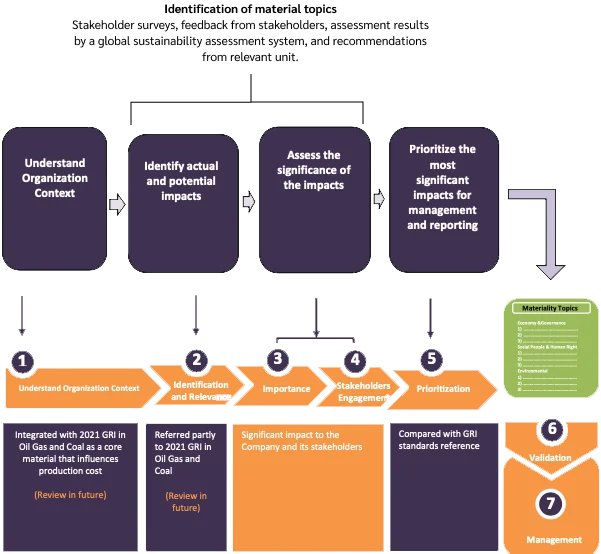
In 2023, SUTHA prepares its sustainability report in reference to the 2021GRI standards (GRI 3: Material Topic). together with the Course S04, (Materiality and Sustainability Risk Analysis), a course sponsored by the Stock Exchange of Thailand then involves the Company sustainability management team and trained personnel, a total of 17 persons.
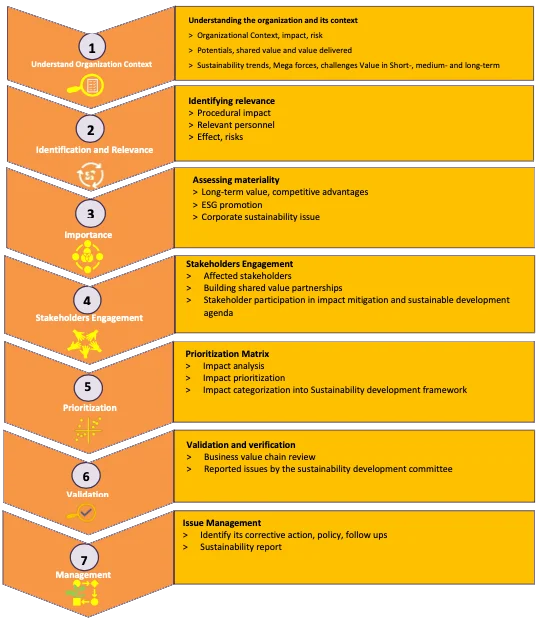
Understanding the needs from internal parties brainstorming, including ESG and ERP (ESG and Enterprise Risk Management following COSO ERP 2017) arising from procedural risks within the supply chain
Identify actual and potential impactsProcedural relevance within business chain from raw material procurement, inbound logistics, quarry management, production and support activities, logistics, sales and marketing, etc.
Assessing issues affecting the business and prioritizing degree of impact of such issues by specifying criteria
0 = not affected, 1 = very little, 2 = little, 3 = moderate, 4 = severe, 5 = very severe.
Stages of issues
Level 1 Latent Latent, a fact that has no scientific confirmation
Level 2 Emerging to be studied and researched but not yet been accepted as a conclusion.
Level 3 Consolidating clear evidence or customary practices (Institution) which do not require evidence
Stakeholder engagement involves engaging with stakeholders on an ongoing basis in order to understand their interests, expectations and concerns to reduce potential impacts on operations and create opportunities for development.
Level 1 Interest stakeholders’ express interest in the said issue/express opinions about such issues at any given time
Level 2 Expectation stakeholders expect the Company to manage or handle some situations in the near future
Level 3 Concern stakeholders are concerned about such issues, damage, risk,
Prioritizing issues
Assessing to prioritize issues that deliver value to maintain competitiveness, to create long-term value for the business, to support business operations in terms of economic, social, environmental,
or sustainability issues that are core foundation of business strategies and activities including budget allocation then prioritizing in each dimension in order to categorizing materiality to portray sustainability materiality
Validation is verifying the validity of the Materiality evaluation process and analysis results to confirm our Materiality that should be prioritized.
This identification process of Materiality is reviewed on a regular basis, and this review ensures the validity of the issue setting and the plans for them to determine business strategies/sustainability strategies or elevate to the organization's risk management or to indicate the future direction of the business including disclosure and communication measures to stakeholders through ESG annual reporting.
Issues Management is to set the sustainability operation framework for selective issues including its strategies, activities and indicators to set goals for sustainability in terms of economics, society, and the environment.